

Look closely at a large fabric canopy, an air dome, or a gas holder. Along the edges and seams you will often see a flat strap running through the fabric. It looks like a small detail, but it is doing a big job. That strap is weldable webbing.
Most people notice the fabric first. Webbing stays in the background. Yet without it, many membrane products would not hold their shape or carry their load for long. This guide explains what weldable webbing is, what it does, and how to choose the right one.
What Is Weldable Webbing?
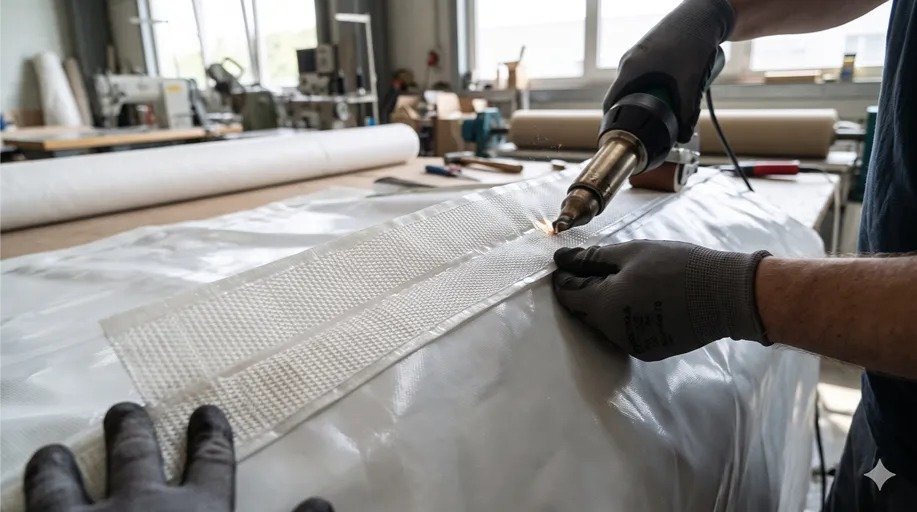
Webbing is a strong, flat, woven strap. Weldable webbing is webbing that can be joined to coated fabric using heat or high frequency welding. Because the surface bonds with the fabric, the strap becomes part of the membrane instead of just sitting on top of it.
You may also hear it called structural webbing tape or fabric strap reinforcement. The names change, but the idea is the same: a strong strap that works together with the fabric.
Weldable Webbing Function: What Does It Actually Do?
The weldable webbing function is to take load. Coated fabric is strong, but it is not meant to carry every pull on its own. Webbing gives the fabric a path to spread that force.
Here is what it does in daily use:
- Carries load. Webbing takes the pulling force so the fabric does not tear at stress points.
- Strengthens edges. Edges and corners face the most pull. Webbing keeps them from fraying or stretching.
- Supports attachment points. Rings, hooks, and tie-downs need a strong base. Webbing gives them one.
- Spreads stress. Instead of one small spot taking all the force, the strap shares it across a longer line.
- Helps hold shape. In products that need to stay tight and even, webbing keeps the fabric from sagging or distorting.
This is why it is called a hidden reinforcement. When it works well, nobody sees it. When it fails, everybody notices.
Why Weldable Matters
You could sew a strap onto fabric, but stitching has a weakness. Every stitch puts a tiny hole in the coating. Over time, water can enter through those holes, and stress can gather around them.
Welded webbing avoids this problem. The strap fuses with the coated surface, so the join is continuous. There are no needle holes along the line. The result is a cleaner, sealed, and often stronger connection.
This is especially useful in products that must stay waterproof or airtight, like gas membranes and air domes.
PVC Coated Webbing Fabric: How It Works
For welding to work, the webbing needs a surface that bonds with the fabric. This is where PVC coated webbing fabric comes in. The woven strap is given a PVC coating, which makes it compatible with PVC coated membrane fabric.
When heat or high frequency is applied, the two coated surfaces soften and fuse. After cooling, they act as one piece. A good bond here depends on matching materials, clean surfaces, and proper welding settings.
PVC and PP Webbing: Know the Difference
Two common types are PVC coated webbing and PP (polypropylene) webbing.
PVC coated webbing is built for welding. It joins well with PVC coated fabric and suits membrane work where the strap must become part of the material.
PP webbing is a light, flexible strap often used for general strapping and attachment needs. It works well where a simple, strong strap is needed and the join method suits it.
Which one is right for you depends on how the strap will be used and how it will be attached. A good supplier will help you decide instead of pushing one option.
Where Membrane Reinforcement Webbing Is Used
Membrane reinforcement webbing is found in many fabric products, including:
- Tensile membranes and canopies: along edges and at anchor points
- Air domes: for load paths and attachment lines
- Biogas domes and storage balloons: to strengthen seams and edges
- Truck covers and tarpaulins: at edges, corners, and tie-down areas
- Roll-up doors: to support the fabric during movement
- Flexi tanks and liquid containers: for handling and load support
- Pond liners and oil booms: where straps help hold and position the membrane
In each case, the webbing does the same quiet work: it takes the strain so the fabric can do its job.
What to Check Before Choosing Webbing
Not all webbing is the same. Keep these points in mind:
- Strength for the job. The strap should match the load it will carry. Ask your supplier for strength details.
- Compatibility with the fabric. For welded joins, the webbing coating should suit the membrane fabric.
- Weld quality. A clean, even weld matters more than the strap alone. Ask how the join is made and checked.
- Weather resistance. If the product will be outdoors, the webbing needs to handle sun and rain as well as the fabric does.
- Width and thickness. These should suit the size of the product and the forces involved.
- Consistency. The webbing should perform the same from one batch to the next.
Treat the webbing as seriously as the fabric. A strong membrane with weak reinforcement is still a weak product.
Choosing a PVC & PP Webbing Manufacturer
If you are looking for a PVC & PP Webbing Manufacturer, do not stop at the strap itself. Ask these simple questions:
- Is the webbing suitable for welding with PVC coated fabric?
- What is the strap made of, and how is the coating applied?
- Can it be supplied in the width and strength I need?
- How is quality checked?
- Will someone help me match the webbing to my fabric and use case?
A good manufacturer or supplier answers in plain words and helps you pick the right option. That support often matters as much as the product.
Why Choose Lucky International
Lucky International works with engineered PVC and PVDF coated fabrics for a wide range of technical textile products. The coated textiles are engineered by SIOEN Industries of Belgium and shaped into finished products locally, so customers get the benefit of well-known technical fabric along with local support. Because the company works across tensile membranes, air domes, gas membranes, truck covers, flexi tanks, and more, the team understands how reinforcement and welded joins affect real products, not just the fabric on its own. If you are looking for a PVC & PP Webbing Manufacturer or want help matching webbing to your membrane fabric, you can talk to the Lucky International team about your requirement and get guidance on the right fit.