


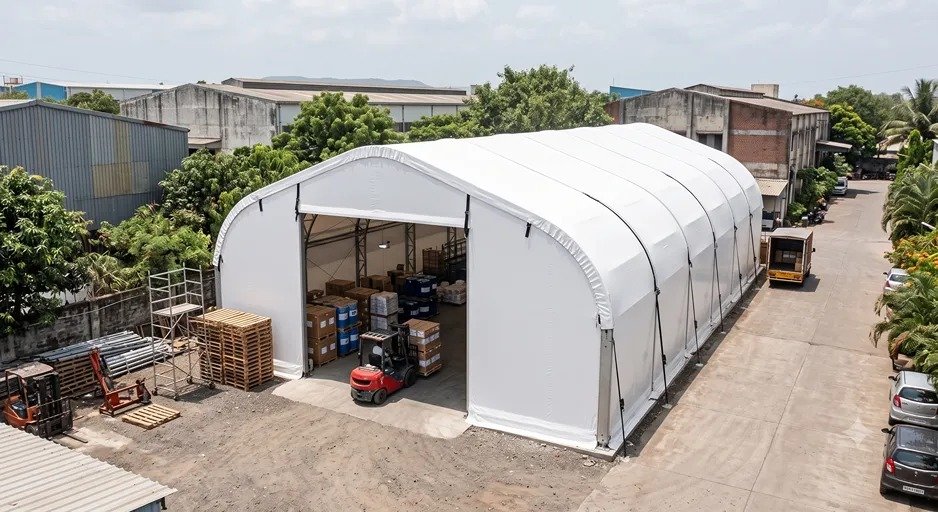
UV and Weather Resistance Tent Fabric: What to Check for Hangar Structures
Hangar tents and large temporary structures are exposed to sunlight, rain, dust, wind, and changing temperatures. Choosing the right UV and weather resistance tent fabric is therefore essential for maintaining the performance and appearance of the structure over time.
A suitable membrane fabric should provide protection against outdoor exposure while offering the strength, flexibility, and durability required for large-span applications. For hangar tents, industrial shelters, aircraft storage, and temporary warehouses, fabric quality can directly affect the reliability of the overall structure.
Why Is UV Resistance Important for Hangar Tent Fabric?
Continuous exposure to ultraviolet radiation can gradually affect the surface and mechanical properties of textile materials. A fabric designed for outdoor structures should therefore have appropriate UV resistance.
UV resistant hangar fabric helps provide protection against prolonged sunlight exposure and can support longer-lasting performance when the material is correctly selected and installed.
UV resistance is particularly important for hangars located in regions with strong sunlight or structures that remain installed for extended periods.
What Makes Weatherproof Tent Fabric Suitable for Outdoor Use?
Weatherproof tent fabric should be capable of handling common outdoor conditions such as rain, sunlight, humidity, dust, and temperature changes.
Important characteristics include:
- UV resistance
- Water resistance
- Weather resistance
- Mechanical strength
- Dimensional stability
- Reliable seam and welding performance
- Resistance to surface contamination
- Suitable coating protection
The required performance depends on the location, structure design, exposure conditions, and intended service life.
How Does PVDF Lacquer Improve Fabric Performance?
A PVDF lacquer or protective surface coating can provide an additional layer of protection to coated textile fabric. It can help improve resistance to environmental exposure and support the long-term appearance of the membrane surface.
For hangar tents and other outdoor structures, a protective coating can be particularly useful where the fabric is exposed to sunlight, rain, dust, and changing weather conditions.
The coating specification should be evaluated together with the fabric base, PVC coating system, and intended application.
Why Is Abrasion Resistance Important in Hangar Tent Fabric?
Abrasion resistant fabric can be beneficial during fabrication, transportation, installation, and regular use. Large membrane panels may experience friction or contact during handling and installation.
Good abrasion resistance can help reduce surface damage caused by repeated handling or contact with supporting components.
For industrial and hangar applications, the fabric should be selected according to the expected handling and operating conditions.
What Is Mildew Resistant Tent Fabric?
Mildew resistant tent fabric is designed to reduce the risk of mildew-related deterioration under suitable conditions.
Humidity and moisture can create an environment where biological growth becomes a concern, particularly in enclosed or poorly ventilated structures. A fabric with appropriate resistance can help maintain the surface and functional properties of the membrane.
This can be relevant for hangars, storage shelters, warehouses, and temporary structures located in humid or rainy environments.
How Does Dirt Resistant Tent Coating Help?
A dirt resistant tent coating can help reduce the adhesion and accumulation of dirt and contaminants on the fabric surface.
This can support easier maintenance and help preserve the appearance of large membrane structures. It is especially useful for hangar tents and industrial structures located near roads, construction areas, manufacturing facilities, or dusty environments.
Surface performance depends on the coating technology, environmental conditions, and maintenance practices.
What Should You Check When Selecting Hangar Tent Fabric?
When selecting fabric for a hangar tent, consider the complete set of technical requirements rather than focusing on a single property.
Review:
- UV resistance: Important for structures exposed to prolonged sunlight.
- Weather resistance: Helps the membrane withstand rain, humidity, temperature changes, and outdoor exposure.
- Tensile strength: Important for large-span membrane structures and structural loading requirements.
- Tear strength: Helps the fabric resist tearing during handling and use.
- Abrasion resistance: Useful where the fabric may experience repeated handling or contact.
- Mildew resistance: Relevant for humid and moisture-prone environments.
- Surface protection: A suitable coating can improve resistance to dirt and environmental exposure.
- Weldability: Consistent welding properties are important when joining membrane panels.
Where Is UV Resistant Hangar Fabric Used?
UV resistant hangar fabric can be used for a variety of temporary and semi-permanent structures, including:
- Aircraft hangars
- Equipment storage shelters
- Industrial warehouses
- Vehicle shelters
- Construction site structures
- Logistics and storage facilities
- Event and temporary structures
- Agricultural and industrial shelters
The fabric specification should be matched to the structural design and environmental conditions of each application.
How Does Weather Resistance Affect the Service Life of a Fabric Structure?
Weather exposure is one of the key factors affecting the long-term performance of an outdoor membrane. Continuous sunlight, rain, humidity, dust, and temperature fluctuations can place additional demands on the fabric and coating.
Selecting a fabric with suitable UV, weather, abrasion, and surface resistance can help the membrane maintain its intended performance over its service period.
However, actual service life also depends on structural design, installation quality, maintenance, environmental exposure, and frequency of use.
Why Choose LUCKY International for Weather-Ready Fabric?
LUCKY International supplies coated textile solutions for applications requiring outdoor durability and weather resistance.
Its fabric range includes PVDF lacquered fabric, designed for applications where UV resistance, weather protection, surface performance, and durability are important considerations.
For hangar tents and other large-span structures, fabric selection can be matched to the project's environmental conditions, structural requirements, fabrication process, and expected service life.
FAQs
What is UV resistant hangar fabric?
UV resistant hangar fabric is designed to withstand prolonged exposure to ultraviolet radiation while maintaining suitable performance for outdoor structural applications.
What makes tent fabric weatherproof?
Weatherproof tent fabric combines suitable coating and fabric properties to provide resistance against outdoor conditions such as rain, sunlight, humidity, and temperature variations.
Is PVDF coating suitable for hangar tents?
PVDF coating can be suitable for outdoor hangar tent applications where additional surface protection, UV resistance, and weather performance are required.
Why is mildew resistance important for tent fabric?
Mildew resistance can help protect fabric surfaces in humid or moisture-prone environments and support longer-lasting material performance.
How can dirt-resistant coating benefit a hangar tent?
Dirt-resistant surface properties can reduce the accumulation of contaminants and help maintain the appearance and ease of maintenance of the fabric.