


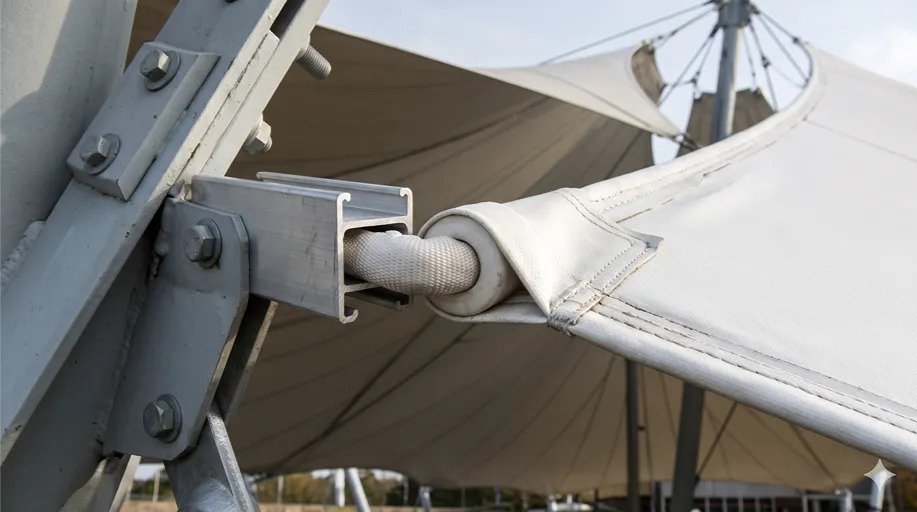
Look closely at the edge of a tensile membrane panel and you will often see a thin rope or bead running along it. This small detail is called a keder. It is easy to miss, but it plays a big part in how a fabric panel stays firm, flat and secure.
If you are new to tensile fabric work, this guide explains what a keder is, how it works and what to look for when choosing fabric panels that use one.
What Is a Keder?
A keder is a flexible rope or bead that is fixed along the edge of a fabric panel. It is usually made of PVC or a similar flexible material. The fabric edge wraps around it, and the two are joined so the rope sits inside a neat fold or pocket.
The keder slides into a matching channel, so the fabric can be held along its whole edge instead of at a few single points. This spreads the pull evenly across the membrane. The result is a smooth, tight surface with fewer wrinkles and less stress on any one spot.
Think of it like the bead on a curtain track. The bead sits inside the track, and the fabric hangs evenly along its length. A keder does the same job for a membrane panel.
Why Keders Matter in Tensile Fabric Work
A tensile membrane stays stable because it is held under steady tension. If the edges are weak or uneven, the whole panel can sag, flutter or wear out early. The keder helps in several ways:
- Even tension. The pull is shared along the full edge of the fabric, not just at corner points.
- Edge strength. The folded and joined edge gives the fabric extra support where the load is highest.
- Neat finish. The panel sits straight and clean, which gives a crisp, professional look.
- Easy fitting. Because the keder slides into a channel, the panel can be placed in a smooth, orderly way.
This is why a keder is often called a tensile structure accessory. It is small, but the whole panel depends on it.
Keder Profile Fabric: How the Edge Is Made
A keder profile on fabric is made by joining the rope or bead to the edge of the panel. The fabric is folded around the keder, and the layers are fixed together so the rope stays firmly in place. For PVC and PVDF coated fabrics, heat welding is a common way to join the layers, since the coating bonds well under heat and the join stays watertight.
A well-made keder edge should look:
- Straight and even along the full length
- Firmly joined, with no gaps or lifting
- Smooth, with no loose threads or rough patches
- Consistent from one panel to the next
When many panels sit side by side, small differences in the edge can show up as ripples or gaps. Accurate cutting and careful joining at this stage make a clear difference to the final look.
Common Keder Styles
Keder details come in a few common styles. The right one depends on the design and the way the panel is held.
Single Keder Edge
A single rope runs along the edge of the panel. This is a simple and widely used style for many kinds of membrane panels.
Keder Rope in a Fabric Pocket
The edge of the fabric is folded to make a pocket, and the keder rope sits inside it. This gives the rope a snug, protected position.
Keder Strip Joined to the Edge
A separate strip with a bead is joined to the fabric edge. This is useful when the panel needs a clean, defined edge detail.
Each style serves the same goal: a strong, tidy edge that can hold tension well.
Why the Fabric Matters for Keder Edges
A keder is only as good as the fabric around it. The edge carries a lot of the load, so the fabric must be strong and stable. PVC and PVDF coated fabrics suit this work well for a few reasons:
- The base fabric is strong. A tough polyester base handles tension without stretching out of shape.
- The coating joins well. PVC coating bonds cleanly under heat, so folded edges and joined layers stay secure.
- The surface is smooth. The panel looks neat, and the edge detail sits cleanly along the fabric.
- The finish is protective. PVC coated fabric resists water, and PVDF coated fabric adds a top layer that helps the surface stay clean and neat.
A good fabric with a poorly made edge can still fail, and a well-made edge on weak fabric will not last. Both parts need to work together.
What to Check in Keder Fabric Panels
Whether you are a dealer, a contractor or a business buyer, a few simple checks can help you judge the quality of keder fabric panels.
- Look at the edge line. It should run straight without waves.
- Check the join. The fabric should be firmly bonded around the rope, with no gaps.
- Compare panels. Matching panels should have the same edge size and finish.
- Ask about the fabric. Find out which coated fabric is used and where it comes from.
- Ask about the process. A good supplier can explain how panels are cut and joined.
- Match the keder to the design. Make sure the keder style and size suit the way the panel will be held.
If a supplier answers these points clearly, it usually means they know the work well.
Small Details, Big Results
In tensile fabric work, the small parts often decide how good the final result looks and feels. The keder is a good example. It does not stand out, but it keeps the membrane flat, tight and steady. A clean edge makes the whole panel look better, and a strong edge helps the fabric hold its shape.
When you plan a project, treat the edge detail as seriously as you treat the fabric colour or the finish. It is a small choice with a large effect.
Why Choose Lucky International
Lucky International focuses on PVC and PVDF coated fabrics, the materials that suit keder edge work so well. The coated fabric comes from SIOEN Industries, Belgium, and is shaped into finished panels locally to match what each customer needs. As a PVC fabrics manufacturer in India, Lucky International keeps its attention on the fabric itself, from choosing the right material to cutting and finishing it with care. For dealers, vendors and businesses looking for dependable Keder Fabric & Solutions, this gives one clear source for good quality coated fabric and neat, accurate panels.