


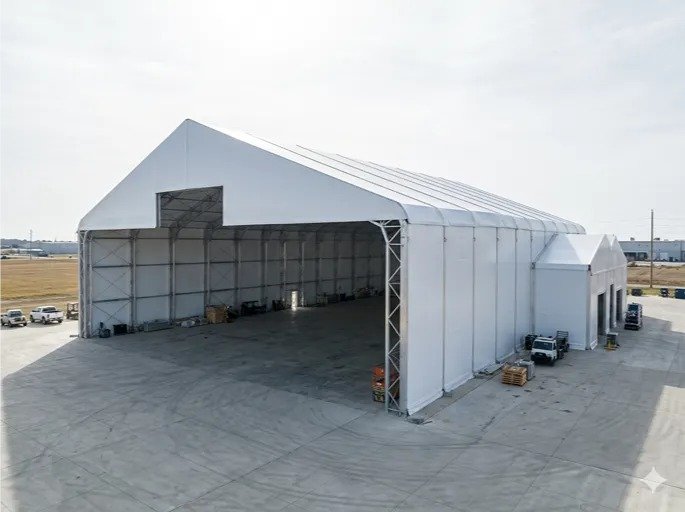
When a buyer overseas looks at an aluminum hanger or tent, the first thing they judge is the cover. The cover takes the sun, the rain, the wind and the daily wear. It is also the part the buyer’s own customers see and touch. So the fabric decides how the whole tent is received in the end.
This guide looks at what global buyers expect, and why the fabric is the best place to start.
Why Global Buyers Look Closely at Tent Fabric
A buyer in another country cannot walk into your factory every month. They rely on papers, samples and a clear description of the material. They want to be sure that what arrives matches what was promised.
For this reason, serious buyers search for a hangar tent export partner who can explain the fabric in plain words and back it up with proper records. A vague answer is a red flag. A clear answer builds trust fast.
What Global Buyers Expect From Aluminium Tent Exporters
If you want to understand what global buyers expect from aluminium tent exporters, start with a simple list. Most buyers look for the same things.
- A clear fabric type. They want to know if the cover is PVC or PVDF coated fabric.
- Weather performance. The fabric must handle strong sun, heavy rain and wind.
- Fire behaviour. Many countries ask for fabric that meets local fire rules.
- Strong, clean seams. Welded joints must be even and tight.
- Consistent quality. The tenth order should look like the first.
- Good records. Test reports and batch details should be easy to share.
- Safe packing. Fabric panels should reach the port and the site in good shape.
Notice how most of this list is about the cover. The frame matters, but the fabric is the part that is seen, tested and talked about.
Understanding Global Standards for Tent Fabric
People often use the phrase aluminum frame tent global standards as if it were one single rule book. It is not. Each country, and often each project, has its own rules. A tent for an exhibition hall in one region may face different checks than a warehouse hanger in another.
What stays the same is the direction of the checks. Buyers and local authorities usually look at:
- How well the fabric handles fire.
- How well it resists water and weather.
- How strong the fabric and its seams are.
- How well it holds up under sunlight over time.
The best way to prepare is to know your fabric well. When you can explain what the coating does, how the fabric is welded and what tests were done, global standards become much easier to meet.
PVC and PVDF: The Two Fabrics Behind Most Tent Covers
Most professional tent and hanger covers are made from PVC coated fabric or PVDF coated fabric. Both start with a strong polyester base. A coating is then applied on both sides.
PVC coated fabric is strong, flexible and waterproof. It is a trusted choice for covers that need to be durable and easy to weld into large panels.
PVDF coated fabric has an extra top finish. This finish helps the surface stay cleaner and handle sunlight better over time. It suits covers that need to keep a good look in open, sunny places.
Both fabrics can be cut into exact panels and welded with clean seams. This is what makes them so useful for exhibition tents, event tents and hanger covers that are shipped across borders.
Exhibition Tents: Where Fabric Gets Noticed Most
An exhibition tent exporter knows that these tents are seen by thousands of people. The fabric is in plain sight. Any wrinkle, stain or uneven seam shows up quickly.
Buyers in this space care about a smooth surface, even colour and clean lines. They also care about fabric that can be packed, shipped and used again for many events. A strong coated fabric helps with all of this.
Hangar and Warehouse Covers: Built for Long Use
Hangar and warehouse tents work hard. They face weather every day and often stay in place for a long time. Here, buyers care most about water resistance, strong seams and a surface that does not break down quickly in the sun.
When you speak to a buyer about these tents, talk about the fabric first. Explain the coating, the welding and the finishing. That is what gives them confidence that the cover will keep doing its job.
Searching for an Aluminum Tent Structure Supplier India
Many overseas buyers type phrases like aluminum tent structure supplier India into a search box. They are looking for a dependable source in India that understands the needs of a global project.
When they start that search, a good partner makes three things easy to see:
- What fabric is used, and where it comes from
- How the fabric is cut, welded and finished
- How orders are prepared for export
A supplier who can answer these clearly, with fabric at the centre, stands out from the rest.
Why Choose Lucky International
Lucky International works with PVC and PVDF coated fabric for tents, hangers and many other uses. The coated textile is sourced from SIOEN Industries in Belgium. It is then shaped into finished panels locally, to the size and need of each order.
For a global buyer, this gives a clear story to rely on. The base fabric comes from an established European source. The cutting, welding and finishing are handled by one team, so the quality stays even from the first panel to the last. You can see the range at luckyinternational.net.
If you are looking for a Tent Fabric Manufacturer in India who can speak the language of export buyers, Lucky International is ready to talk about your fabric needs, your panel sizes and your shipping plans.